

Stem Cells and Strategy
How do you inject vitality in aging organizations

We all start from a single cell and this cell over months multiplies and differentiates into cells like hepatocytes (liver), nephrons (kidney), neurons (brain), cardiomyocytes (heart) forming the entire organism. Differentiation is a key characteristic that has helped us evolve into complex organisms over billions of years.
The first cells are called Totipotent cells. They can transform into any cell (even cells outside of the organism, like the placenta that supports growth in the womb). So a totipotent cell, if given the right medium, can generate into a full organism.
At some point, totipotent cells become pluripotent cells. Now, they can still form all cells in an organism but not the outside structures like placenta to help support growth.
Then pluripotent eventually transform into more differentiated cells and generate cells like hepatocytes, nephrons, neurons and others.
These potent (toti/pluri) cells are more commonly known as stem cells.
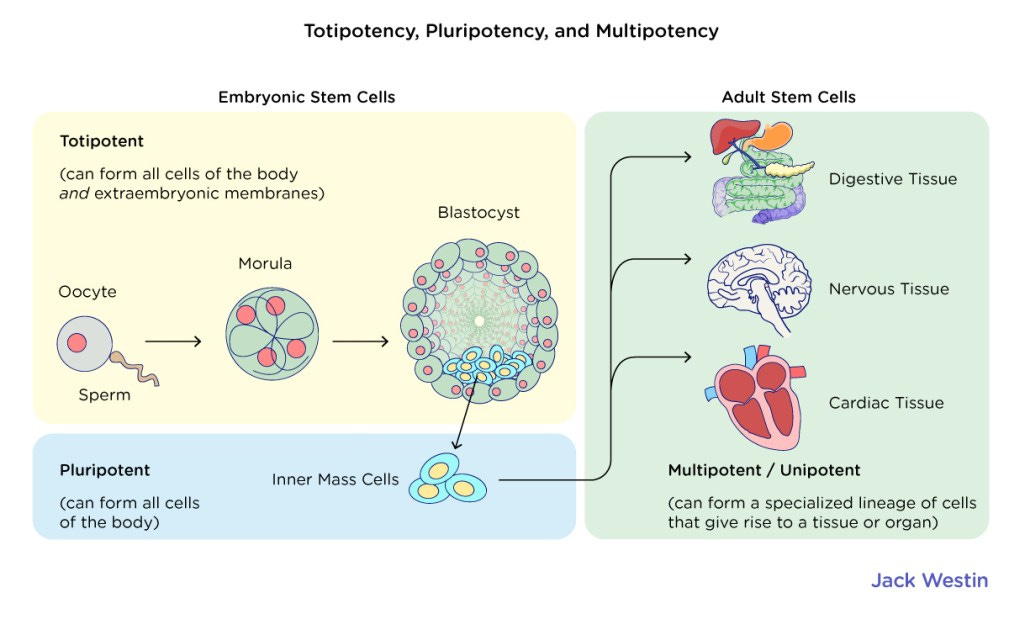
As the organism ages, differentiation is also what limits its ability to regenerate. A neuron once destroyed finds it extremely difficult to regenerate. The differentiated cells can only regenerate into their own types. So if the heart needs help in regeneration, the liver cells suddenly cannot migrate and transform into cardiomyocytes. There are some cells which can generate into many types – Bone marrow – can generate in bone, blood cells, fat etc but this is an exception rather than the norm.
As the organism ages, the ability of these differentiated cells continues to diminish due to DNA damage and eventually the organism starts to fail and dies.
So how do you keep someone immortal? Give them totipotent or pluripotent stem cells. So that they keep repairing damaged cells or generate an entirely new organism if needed.
Now a way to do this (non controversially) is to re-engineer a normal adult cell and prompt it into being a stem cell. This is an area of research which has been going on for sometime now and promises cure for many diseases as well as prolonging lifespan.
Why stem cells and how does this relate to strategy?
Well we can relate the lifespan of a company with that of an organism. In the beginning, every company has 2 to 3 founders. I see them as totipotent or pluripotent stem cells. They form the entire company. They carry out all functions from HR, to sales, to product development to R&D. These individuals know no boundaries. These startup founders use this totipotency to sometimes form multiple startups over the years. Case in point - Michael Scott!!!!

Once the company matures though, we end up getting more differentiated cells - HR function, Marketing function, Sales function crop up and people are assigned more restricted roles. They are more defined and are supposed to be more productive.
But then over a period of time, the functions get biased, rooted in rigid processes, resistant to change and all of this adds up across the organization making it slow to react and beginning to depict characteristics of old age.
Now the question of immortality or rejuvenation comes in – how do we introduce these stem cells back in these highly differentiated, ageing functions to give a fresh breath of life to the organization.
Below are a few ways by which companies try to do this.
1. Mergers and Acquisitions
Sometimes companies try to buy a new company including capabilities to inject vitality or fresh life in an organization. We know that most of the acquisitions fail. Some claim this number to be higher than 90%. So why does this form of vitality or longevity fail?
Well I see acquisitions and mergers more as organ transplants (from another company) rather than injecting stem cells (which are usually from the host company itself). The transplanted organ was thriving in a different environment. Now when you bring it into a new (diseased environment) most of the time it will be rejected as the host conditions to accept this transplant do not really exist.
In medicine we give drugs to suppress the immune system of a patient to enable the transplanted organ to find home. In an organization that would be similar to subverting or changing the culture and processes to let the acquisition flourish. More often than not, this is difficult to accomplish.
2. Ventures
A venture is a small startup or project within a large company that has a high risk high reward potential. These are usually treated differently from core business and are sometimes part of the big bets a business might undertake.
A venture within a company has a higher chance of success than an acquisition because it is made from the same thread as the rest of the org (so no rejection due to culture unlike an acquisition). But for a venture to grow it needs a different culture or medium than the rest of the organization. Which usually means housing it separately, using different measures for success and protecting the team from being pulled in business as usual tasks.
So ventures are a more sustainable way of inducing such vitality and follow an induced stem cell approach.
3. Rotating Talent
A key element of a stem cell is that it is not differentiated. It can transform into cells to perform any function. A key way to do this is by having a talent pool that has worked across functions or departments in the organization.
Now this is more structural and oftentimes needs to find the right balance. Because you need differentiation for maximizing efficiency but you also need a group of people who are wandering around the organization to keep this ability to generate fresh, young ideas. The wandering nature prevents the individuals from developing strong bias and having rigid thinking (similar to the DNA damage caused in mature differentiated cells that leads to ageing).
While many companies have such cadres, not all of them are structured well. A big point we have observed is that such programs are too focused on curating leaders and not focused on creating such talent at all levels of the hierarchy.
4. Reorganization
Another way to reinject vitality in an organization is reorganization. It breaks the existing structures and might induce some of the more differentiated individuals to look for more generalist roles and bring back some more free thinking in the organization.
Note I mention reorganization and not layoffs. I think sometimes companies are more focussed on layoffs (to cut costs) but miss the point on how to reorganize properly as that is more influenced by internal politics. Thus truly missing the opportunity to induce that undifferentiated state in departments and individuals.
Immortality is a myth (for now) but there are ways we can try to increase an organization’s life span by introducing stem cellish behaviour.
Hope you had fun reading this post. See you all next week.
I have a biotechnology background but pivoted into consulting. I breathe strategy for a living but oh my, I never considered this analogy before. Great read!
Great read, keep these coming!